
The Disappearing Truth: When AI Turns Photography into a Blueprint
In an age where artificial intelligence is redefining creativity, photography is one of the most profoundly affected art forms. The technology is undeniably impressive—AI can now enhance lighting, swap skies, clean up imperfections, even generate entire scenes from scratch. But with this rapid advancement comes an unsettling question:
What happens when the camera stops being a tool for capturing truth, and becomes merely a sensor for feeding data into an algorithm?
📷 Photography or Promptography?
Once, photography was about waiting for the light, learning the technicalities of a lens, and being present for the moment. Today, with smartphones and AI, that process is being stripped down to a mechanical gesture. Point, shoot, and let the software do the rest.
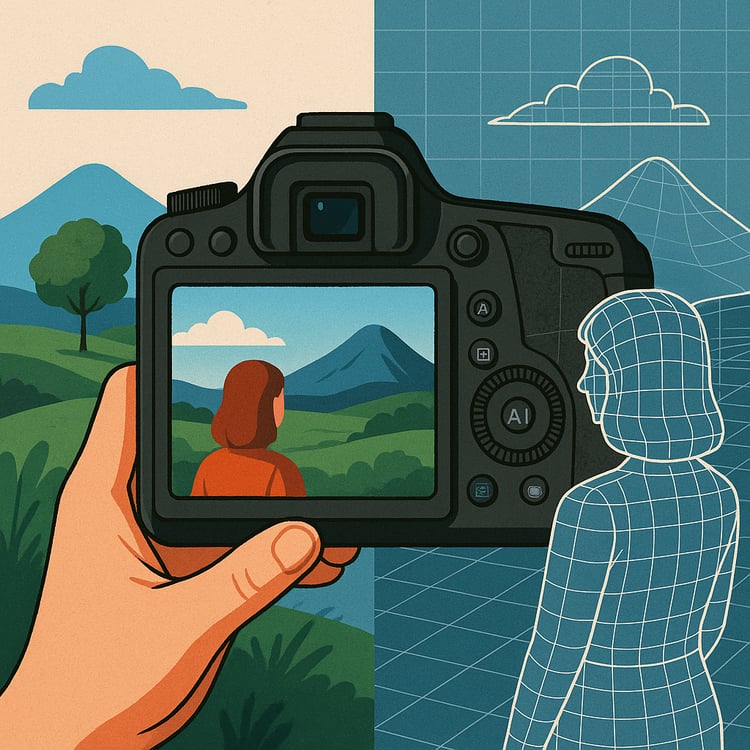
But we're now nearing a future where even that image might be nothing more than a blueprint—a placeholder for AI to build its own reality. A photograph could soon be less about what was in front of the lens and more about what the algorithm decides should be there.
That breathtaking sunset? AI-enhanced. That glowing skin? AI-corrected. That mountain vista? Partially imagined.
🎨 The Art of Seeing vs. the Art of Suggesting
Photography has always been part art, part documentation. The best photographers, like Steve McCurry, Henri Cartier-Bresson, or Dorothea Lange, didn't just click—they saw. They composed. They felt the moment.
If AI can generate ideal lighting, fill in details it deems missing, and "improve" compositions after the fact, the photographer’s role shifts from creator to suggestor.
The result? A potentially dangerous loss of authorship and authenticity.
🧠 Who Owns the Image?
When an AI fills in 40% of a photo’s content based on training data scraped from millions of images online, who is the real author? The photographer? The algorithm? The thousands of unknown artists whose images trained the model?
As AI continues to be embedded in devices—from phones to high-end DSLRs—we face murky legal and ethical waters. The line between “editing” and “generating” blurs. If your photo is mostly invented, is it still yours?
🧍The Loss of Human Presence
Perhaps most critically, AI has the potential to sever the human connection in photography. A photo taken by a human, of another human, in a real moment, holds a weight that no generated image can replicate.
When the lens becomes just a data-collection device, and the image is largely synthetic, we lose the imperfections, the spontaneity, the unpredictability—the soul of photography.
🛑 The Case for Creative Restraint
This is not a rejection of AI. Used responsibly, it can enhance workflow, provide accessibility, and open new creative avenues. But photographers must ask themselves: Where do I draw the line?
Will you let AI guide your editing, or let it create the scene? Will you use it as a tool, or let it dictate your vision?
Because if we let go completely, the “photograph” could become a hollow echo of reality—a polished fiction born not of human eyes, but of neural networks.
Final Thoughts
The future of photography doesn’t have to be dystopian. But we must stay vigilant. We must remember that photography is not just about beauty or technical perfection—it’s about truth, presence, and humanity.
And no matter how advanced AI becomes, those qualities can only come from a soul behind the lens, not a circuit behind the screen.
Have thoughts on the AI vs. authenticity debate? Leave a comment below or share how you're navigating this new digital frontier.
Comments ()